Digital nomad New York

How to run a consulting business while being a digital nomad

For a few years, I lived a version of work that looked flexible from the outside and quite operationally intense from the inside.

I was running consulting projects while travelling through Prague, the UK, Dubai, South Africa, Norway, New York, Atlanta, Los Angeles, Michigan, and Miami. I hosted client sessions from airports, hotel rooms, and around wedding trips in Norway and South Africa. At points I was working part time, but still had days with seven client meetings across different timezones.

At one stage, I was managing up to 17 projects at once.

That lifestyle only worked because the delivery process was structured. Not over-engineered. Not buried in admin. Just structured enough that the next client meeting, the right link, the right preparation, and the right stage of the project were obvious.

A booking tool became a surprisingly important part of that.

It was never just about avoiding back-and-forth emails

Most people think of calendar booking tools as a way to avoid the “when are you free?” email chain.

That is useful, obviously. But in consulting, the bigger value is not simply helping someone pick a time. The bigger value is making the meeting mean something inside the wider process.

I was not taking one generic type of call. I was running kickoff calls, live training sessions, implementation sessions, process reviews, handovers, and milestone check-ins. Each one required a different kind of preparation.

When the event name in my calendar was clear, I knew what mode I needed to be in before I joined. If it said live training, I knew I was teaching. If it said process review, I knew I needed to check progress and decisions. If it said handover, I knew context needed to move between people.

That small detail matters when you are jumping between projects, timezones, and client stages. A calendar full of vague calls is mentally expensive. A calendar full of clearly named meeting types is much easier to run.

The booking links lived inside the process

The best consulting processes do not depend on memory.

When a client reached a milestone, the relevant meeting link was already part of the template. If they completed one stage, the next instruction included the correct booking link. If they needed training, the training link was there. If they needed a review, the review link was there.

That meant I was not manually deciding the next booking step every time. The process already knew what should happen next.

This is one of the things I think many businesses underestimate. A booking link is not just a convenience you paste into an email. Once you are running repeatable work, the booking link becomes part of the operating system. It lives in templates, playbooks, onboarding emails, project plans, internal notes, and milestone instructions.

If those links are vague, outdated, or hard to find, the whole process starts to wobble. That is also why I care about fallback scheduling options. If a booking link has made its way into a template, workflow, or old email, the process needs a way to avoid sending clients into a dead end when a person is no longer available.

Forms helped me avoid wasted calls

One of the most useful things a booking flow can do is ask a few questions before the meeting.

In consulting, I often needed to know whether the client had completed a specific step before the next session. Had they watched the training? Had they imported the data? Had they spoken to the team? Had they made the decision we needed before the call?

If they had not done the prep, the meeting changed shape. Sometimes that was fine, but I wanted to know before I joined, not ten minutes into the call.

This is why I like booking forms. Used well, they are not admin for the sake of admin. They protect the quality of the conversation. They help the host arrive prepared, and they help the client think about what needs to happen before the meeting.

Clients needed to move things without waiting for me

I worked with operational leaders and business owners. Their diaries moved constantly.

Someone had a client issue. A partner meeting moved. A workshop ran over. A team member was off sick. A decision was delayed. Rescheduling was not unusual; it was part of normal delivery work.

If every reschedule had required someone to email me and wait for new times, the whole process would have slowed down, especially when I was in a different timezone.

A good booking system lets the client move the meeting within the rules you have already set. You still control your availability, but you do not have to personally coordinate every change.

That sounds like a small thing until you have a full week, a moving travel schedule, and a client in another country who just needs to shift a session by a few days.

Timezone clarity protected trust

When you are working from Prague one month, Dubai another, and South Africa after that, timezones stop being a technical detail.

They become part of the client experience.

A timezone mistake makes you look less organised than you are. The work might be good, the relationship might be strong, but if someone turns up at the wrong time, trust takes a small hit before the meeting even starts.

Using a proper booking tool meant the client could choose from times they understood, and the meeting landed in both calendars correctly. Nobody had to calculate offsets manually. Nobody had to wonder whether 10am meant my 10am or their 10am.

Finding the right team link mattered too

Consulting work often needs other people.

Sometimes I needed to bring in a contractor. Sometimes a project needed a specialist. Sometimes work needed to move from sales to customer success, or from implementation to the person who would own the relationship long term.

In those moments, the friction is often not the meeting itself. It is finding the right person’s current link, checking whether it is still valid, and getting it to the client without digging through old documents or chat threads.

This is one of the reasons I care about searchable team booking links and team management. In a busy team, booking links are not only used by the person who owns the calendar. They are used by colleagues, assistants, managers, support teams, and anyone else trying to move work forward.

When more than one person needed to be involved, the meeting became even harder to coordinate manually. A handover might need me and another consultant. A technical session might need a specialist. A client review might need the person who owned the process and the person who owned the relationship. That is where multi-host booking becomes more than a nice extra; it stops the client booking a time that only works for half the people who need to be there.

The lesson I took from it

When you are managing a few projects, you can rely on memory for a while.

When you are managing 17 projects, working part time, moving across timezones, and running different kinds of live sessions, memory is not a system.

The booking setup gave me structure. The event type told me what the meeting was. The booking form told me whether the client had done the prep. The calendar invite told me when and where it was happening. The reschedule link meant the client could move the meeting without another email chain. The process template made sure the right link went out at the right milestone.

If I were running the same delivery model with a larger team today, I would also want clearer booking reports. When meetings are part of the operating rhythm, leaders need to know which event types are being booked, which team members are carrying the load, and where cancellations or reschedules are starting to affect delivery.

That is why I think consultants, practice managers, team leaders, and operators should invest in good booking infrastructure earlier than they think.

Not because it is glamorous. It is not.

Because it removes a lot of small, repeated decisions that otherwise sit in your head all day.

How this influenced calendr.so

A lot of the thinking behind calendr.so came from this kind of work.

I wanted booking software that treated meetings as part of a business process, not just as empty calendar slots. Clear event types. Forms that collect useful context. Self-serve rescheduling. Team links that are easy to find. Multi-host booking when more than one person needs to be there.

Those features sound simple, but they matter when you are trying to deliver good work while everything around you is moving.

A booking link helps someone choose a time. A good booking process helps the right meeting happen at the right stage, with the right preparation, without you manually holding the whole thing together.

The reality of coding with AI

In this post, I wanted to do something a little different – a bit of fun mixed with a warning…

Over the last two years I have been building software with AI. I have been doing this pretty much since the day ChatGPT launched. It’s been a wild ride of ups and downs. Sometimes it was great and sometimes it caused issues that took weeks to resolve but, I could see the potential from the start. Literally, within a couple of days of using ChatGPT I was telling friends and family about how it blew my mind and how important it is that they try it out. While LLMs have become more and more popular – I think most people have not been able to see past getting it to tidy up an email or help with an essay. In this post, I want to show why I think it’s far more powerful than most people understand currently in March 2024.

In the video below, I am going to show how in less than an hour, I create an app from an empty folder on my computer without writing a line of code myself. I am obviously a developer who’s been coding since my early teens but, I have already taught 3 or 4 people to do this who have never written a single line of code.

I want to stress this point – you don’t need years of development experience any more.

I taught one friend how to do this process who owns a staffing agency. He wanted to build an internal tool for managing onboarding new team members. He had the first version of the app up and running with days. His team are now saving time with a more robust process that he has full visibility on. This is a significant improvement in operations and it increases the value of the business because there is high value IP which can now be sold with it. He could also consider making it available for others to use with a monthly subscription.

Speaking of startups, another guy I taught how to build iOS apps is now is about to beta launch his app and is using it to raise $1m in investment. Having the ability to build the app having never written a line of code and built anything like this before allows him to refine the idea and get people to play with the ideas and features so potential users and investors can understand his vision for the business. It also lowers his costs dramatically.

So I have seen first hand how people can create apps with no experience that add significant value to their businesses at little to no cost. You don’t have to take my word for it, I will show you what it’s like step by step with this video…


There is a bit of background knowledge needed to get this up and running but, simple to learn with some guidance. But you can see it’s possible. While this is exciting to see what people are going to build – I had a conversation with a friend in the last few days where we realised that it might be hard to sell your software to people who can make their own version in a matter of hours…


I am keen to see how far people can push this new paradigm so I am thinking of doing workshops or a course or… something. I haven’t quite decided yet. Keep an eye out for it.

What would you build if you could? – let me know here and register your interest in learning how to build with AI here


Working out if you’re building a business with a chance at profitability

I’m currently working on launching an iOS app and am ready to start promoting it. Like any new project, my ultimate goal is to build a profitable business. But instead of diving headfirst into spending, I want to ensure that the numbers work in my favor before scaling up. This post is a breakdown of my thought process, early experiments, and what I’ve learned so far about setting targets for a sustainable app business.

Why PPC Is My Starting Point

When it comes to marketing a new app, there are plenty of options: social media, influencer collaborations, SEO, and more. However, I’ve decided to focus on Pay-Per-Click (PPC) advertising as my starting point. Why?

  • Control: With PPC, I can tightly control who sees my ads, how much I spend, and how I scale campaigns.
  • Immediate Feedback: PPC delivers quick results. I can start gathering data right away to see what’s working and what isn’t.
  • Scalability: If the ads are profitable, I can reinvest and scale up.

But to make PPC work, I need to fully understand the metrics that will make or break this business.

Baseline PPC Numbers From My First Test


I’ve already run a small test campaign to establish some baseline numbers. While I’m still optimizing the ads, targeting, and messaging, here’s what I’ve learned:

  • Cost-Per-Click (CPC): The CPC on my first ads ranged between £0.22 and £0.45, depending on the audience segment.
  • Conversion Rate: I don’t have reliable conversion data yet because the app is still pending approval on the App Store. However, I’m assuming a 5% conversion rate as a starting point for analysis. (This is optimistic but achievable with good ad creatives and landing page optimization.)

What Metrics Should I Be Targeting?

To make this business work, I need to focus on a few key variables:

  1. Price Per Sale
  2. CPC
  3. Conversion Rate
  4. Apple’s Cut: Apple takes 30% of every app sale, which significantly impacts profitability.

Profitability Analysis: Can This Work?

Cost Per Acquisition (CPA):

CPA = CPC / Conversion Rate

For example, if CPC = £0.30 and the conversion rate = 5%:

CPA = £0.30 / 0.05 = £6

Net Revenue After Apple’s Cut:

Apple takes 30% of the app sale price. For example:

  • At £9: £9 × 0.7 = £6.30
  • At £12: £12 × 0.7 = £8.40
  • At £15: £15 × 0.7 = £10.50

Profit Per Sale:

Profit Per Sale = Net Revenue - CPA

If CPA = £6 and the app price is £9:

Profit Per Sale = £6.30 - £6 = £0.30

Sales and Traffic Requirements for £100,000 Profit:

Sales Required = Profit Goal / Profit Per Sale

Traffic Required = Sales / Conversion Rate

At a £15 price point with a 5% conversion rate:

  • Profit per sale = £10.50 – £6 = £4.50
  • Sales required for £100,000 profit = 100,000 / 4.50 = 22,223
  • Traffic required = 22,223 / 0.05 = 444,460

Key Insights From My Analysis

It seems like I need to get a £12 price point with a conversion rate of 4% or more and a CPC of below £0.30 to really make this business work. Which will be hard but, not impossible. Here are a few tables I played about with that got me here…


  • Conversion Rate Is Critical: If the conversion rate falls below 3%, this business is unlikely to be profitable. Even at a 5% conversion rate, I need to ensure my CPC stays below £0.30 to make the numbers work.
  • Higher Price Points Are Better: A price of £15 allows me to reduce the sales volume and traffic requirements compared to £9 or £12 pricing. However, this requires positioning the app as high-value to justify the cost.
  • Apple’s Cut Hurts Margins: The 30% fee significantly impacts profitability. Factoring this in early has been eye-opening, as it increases the importance of keeping acquisition costs low.
  • PPC Alone Isn’t Enough: While PPC is a great starting point, I’ll also need organic traffic from platforms like TikTok, Instagram Reels, and YouTube Shorts to reduce dependency on paid ads.

Next Steps

Here’s what I plan to do next:

  • Optimize Ads and Targeting: Refine ad creatives and audience targeting to lower my CPC.
  • Prepare for App Store Approval: Ensure the app’s landing page and App Store listing are fully optimized for conversions.
  • Scale Carefully: Start with a small budget, measure ROI, and reinvest profits to scale.
  • Test Price Points: Run A/B tests to see how different price points affect conversion rates and overall profitability.

Why This Analysis Matters

This type of detailed profitability analysis has been invaluable in helping me set realistic expectations and targets for my app. It’s easy to get caught up in the excitement of launching and scaling, but without clear metrics, it’s just as easy to spend money without seeing a return.

If you’re building a product or service, I highly recommend taking the time to run the numbers. Even basic models like these can provide clarity and confidence in your decisions.

Closing Thoughts

Launching a business is exciting, but it’s also a numbers game. By starting with PPC and diving into profitability analysis, I’ve gained a much clearer picture of what it will take to make my app a success. Whether or not this exact strategy works, the lessons from this process will guide me in every project I tackle moving forward.

The Problem with “Proven” Email Sequences: Why They Don’t Always Convert

Recently, I had a conversation with my friend Alex (not his real name), a consultant who’s finally ready to launch his first course. Alex has been using social media and content to try and drive more sales for his business, and I’ve been encouraging him to try a course for a while now. So, it’s exciting to see him dive in! But I wasn’t thrilled with his chosen launch method: an email sequence.

There’s a ton of advice out there saying you need an email sequence to launch a course. And sure, if you have tens of thousands of subscribers, it might make sense—the volume can make up for the lower conversion rates. But if you’re like Alex, with a more modest audience, relying solely on email could leave you feeling frustrated with the results. Here’s why I think a more personal, hands-on approach is the way to go, especially if you’re just starting out.

The Reality of Email Sequences: Low Conversion Rates

The stats on email conversion rates might surprise you. Here’s a look at the average numbers:

Average email open rate: Around 20-25%

Average click-through rate (CTR): Roughly 2-3%

Conversion rate after clicking: Typically around 1-2%

Let’s break that down with some real numbers. If you send an email to a list of 1,000 people:

• 200-250 will open it

• 20-30 will click through to your sales page

• Only 1-2 people might actually convert and purchase your course

Even with great copy, it’s clear that email alone doesn’t provide strong odds for someone like Alex, who doesn’t have tens of thousands of subscribers. That’s why I suggested a different approach.

Why you should go with a personal touch

When your audience is smaller, personal outreach can be incredibly effective. Rather than relying on automated email sequences, reaching out one-on-one through email, DMs, or even calls allows you to create genuine connections that are far harder to ignore.

Here’s what I suggested to Alex:

Skip automation for now: Instead, directly engage with people who’ve shown interest in his content. Reach out, ask if they’d like to try the course, and invite honest feedback.

Leverage one-on-one connections: His advantage at this stage is that he can build personal relationships, unlike big-name creators who are often just another email in a flooded inbox.

Use a CRM to stay organized: When managing multiple personal outreaches, organization is key. This is where a CRM like lnks.to can help, letting you track contacts, follow-ups, and engagement in one place.

Comparing the Numbers: Email Sequence vs. Direct Outreach

To illustrate this, let’s look at how a typical email sequence funnel compares to a direct outreach approach:

Email Sequence Funnel:

Social post views: 5,000 people see a post promoting the course

Email list signups: 100 people sign up (2% of views)

Open rate: 25% (25 opens)

Click-through rate: 3% (3 people click to the landing page)

Landing page conversion rate: 10% (0.3 people convert – not even 1 full sale)

With numbers like these, Alex could invest time into a sequence and see minimal returns, simply because his audience size isn’t large enough to offset low conversion rates.

Personal Outreach Funnel:

Outreach (email/DM): Reach out personally to 100 warm leads

Response rate: 40% (40 people respond positively to the initial contact)

Discovery call booked: 25% of those who respond (10 calls booked)

Sales call conversions: 30% of calls convert to a purchase (3 course sales)

By reaching out personally, Alex could see much higher engagement and conversion rates, translating to more sales. The personal approach allows him to showcase the course’s value directly, answer questions, and guide leads through the decision-making process. Not to mention, each interaction builds a stronger relationship, making future sales easier.

Why Scaling Comes Later

The big names in online courses often promote email automation because it works at their scale. When you have hundreds of thousands of subscribers, even a 1% click-through rate can yield thousands of clicks. But for someone like Alex, whose list is modest, the one-on-one approach is far more effective at building trust and converting leads.

I advised Alex to focus on validating his course through personal outreach first, making those initial sales, and refining his pitch based on real feedback. Once he’s confirmed there’s demand, he can consider scaling up with email automation. But right now? His edge is in those personal connections.

Using lnks.to’s CRM to Simplify the Process

One of the reasons I built a CRM into lnks.to is for scenarios exactly like this. When you’re launching a product or course with a smaller audience, every personal interaction counts. The CRM lets you keep track of each person you’ve reached out to, organize responses, and follow up as needed.

Rather than losing potential leads in an email inbox, a CRM keeps everything streamlined so you can stay on top of your outreach. It’s a simple but powerful tool that helps you focus on conversions, not just contacts.

To make it a little clearer, here is a video that shows you how to manage the whole process…

A Final Thought on Launching Courses

If you’re thinking about launching a course and your audience isn’t huge yet, consider trying the personal approach. Don’t get caught up in the automation hype before you’re ready. You might be surprised by how much traction you can get by reaching out directly to people who already know and value your work.

The Reality of Running a Remote Consulting Business: The Mechanics

The reality of how my business works. The mechanics of running a remote consulting business. (Detailed)

Working from Oslo, Norway

I am currently in Dubai. I have flown in to see a close friend of mine who left the UK years ago and has recently moved to Dubai. Before I left for the UK I was talking to a prospect for lnks.to, where we eventually got talking about my consulting and how I work while travelling. Then while in the cab on the way to my hotel from the airport, the driver asked about what I do too. I thought it would be worth explaining here because I think others are too vague and I want to explain why I think the mechanics of the business works.

I am trying to share how the business works so this is going to be less of a deep dive into what I actually deliver but more about the processes that allow me to deliver. A more operational take if you will. That being said, I think I should explain a little about how I help clients because there is some important context here.

Who do I help

In the past, I would help small companies with Marketing and Operations. I would create strategies to help them overcome complex problems then help them roll out the strategy. While I have one or two clients that come to me for ad-hoc advice about marketing strategy and operational questions who are more generic companies, this is rare at this point so when I say “clients” for the rest of this post I am talking about Accounting firms.

More specifically, I work with operational leaders; CEO, Head of Operations, Operations, and Practice Managers within small accounting firms, typically with 10-50 staff, sometimes smaller, sometimes larger.

How I help them

In short I help accounting firms build scalable processes. This means working out the most efficient way to deliver the services they charge for or, processes they use to manage the team. (Sexy, I know)

I will typically help them break down how they are doing the service and what they can do to speed things up. Another example is advising what software they can use to make things easier. Then I advise on how to train the team to take on these new processes and systems. In many cases I deliver the training.

In the majority of cases at the moment, the way I am helping practices achieve this by rolling out Karbon which is a workflow management and communication software.

What does “efficiencies” actually mean?

Let me give you an example…

An accounting firm with 20 staff. They deliver payroll and 8 other services for their 300 clients. To keep things simple, lets say, each of these services require the following steps:

  1. Get information / update from the client
  2. Process the information
  3. Internal Review
  4. Client Review
  5. File

Lets say each of the steps takes time but lets just focus on the stages with client interactions. Requesting the information from the client and chasing them until they hand it over. Typically clients ignore the first couple of requests so this can take a little longer than one would hope. Here is how the process might play out in reality:

  1. Get information / update from the client
    1. Initial request: Remembering which client to chase, composing the email – 10mins
    2. Chase 1: Remembering which client to chase, composing the email – 5mins
    3. Chase 2: Remembering which client to chase, composing the email – 5mins
  2. Client Review
    1. Initial request: Remembering which client to chase, composing the email – 10mins
    2. Chase 1: Remembering which client to chase, composing the email – 5mins
    3. Chase 2: Remembering which client to chase, composing the email – 5mins

That is 40 mins in total. Now all team members doing this for all clients…

40mins x 300 clients = 12,000 mins or, 200 hours

200 hours x 8 services = 1,600 hours

An accountant might earn £20 per hour (assuming the London based accountant is on £45k salary). 1,600 hours x £20 per hour = £32,000.

This is a little misleading because some services like Payroll are done monthly and others are done annually like Statutory Accounts but it’s a good starting point. If anything it would be higher.

This means if we can reduce the time chasing clients from 40mins to 10 mins by using automation to request the information then we might be able to make significant savings in time and money because the time would go down to 400 hours. The cost of those 400 hours would be £8,000.

So we might be able to save the firm in this example £24,000 (£32,000 – £8,000).

I help them find and roll out these kinds of “efficiencies” to get more profitable and save time.

How does my consulting business work

Now, let’s take a look at how I find these clients and manage the process. I was going to say “there is more going on behind the scenes” but to be honest, this is pretty much it…

Acquisition

Let’s start with how I get clients. The main “channels” are:

Referrals: Most of my clients are referrals. This is where someone has worked with me in the past or, wants me to help their client roll out the software / manage an implementation.

Outbound emails: I look for firms online and email the leaders of the business asking if “saving money” or “streamlining delivery” would be useful.

If it sounds like they have issues I can help with, we’ll start a brief sales process.

Offers

When someone is interested in working with me, I typically pitch them one of 3 things unless they have come to me for something specific anyway. The offers typically fall into 1 of the following 3:

  1. Sent number of live training / guidance calls, on something very specific (how to use and setup x part of y software)
  2. Implementation package, this where I will train them on how to manage parts of a software while doing some of the setup for them
  3. Rolling out of larger projects, this is where I will analyse the business, make recommendations and then roll those out. These projects take over a year and I would agree to work x days a week (I hardly ever do this post covid, being prevented from working on site during covid then wanting to work remotely meant I have no longer been interested in this kind of work because it largely has to be done in person)

The pricing around these is pretty much set. I don’t really negotiate and the price is stated pretty early on in the conversations.

  • Package 1: 4 consulting calls at £X
  • Package 2: Full Implementation £Y
  • Custom Project: X Days a per week Y weeks, Daily Rate (Minimum of half day)

There are a few people who have access to my calendar, they book in a call and I send the invoice shortly after. I am looking to set this up in lnks.to where they will fill in a form & pay, then that gives them access to the calendly link.

Delivery

Typically, the process of working with me looks like this, regardless of the package:

  1. We make contact, I add the contact to a contact “follow up list” in my CRM (lnks.to)
  2. We book in a call to discuss what the client needs and if I can help (You will often hear me describe this as a Discovery Call) (Calendly > Google Calendar > Zoom + Slides) if there is a fit, I will create an Opportunity in lnks.to to track them through the sales & delivery process)
  3. Propose process & agree timeline (Email or Zoom call followed up by email, update opportunity dashboard)
  4. First payment (Invoice via Zero or lnks.to product page) & Opportunity moved to “delivery steps” in lnks.to)
  5. Live calls, follow up actions (Zoom call, follow up Emails with Google Sheet worksheets / PDFs, Loom videos)
  6. Monthly invoicing (Xero)
  7. Handover any final deliverables (Zoom call, follow up Emails with Google Sheet worksheets / PDFs, Loom videos)

Toolkit

lnks.to / opportunities
  • lnks.to I have the CRM side of the business in here and I have one or two freebies on this page
  • Karbon
  • Xero
  • Laptop / iPad / iPhone
  • Loom
  • Zoom
  • Calendly
  • Excel / Google Sheets

In conclusion, it’s probably not the sexist business setup you have ever seen but, it allows me to keep things really streamlined to fit my Ideal Average Day. The main benefits are:

I dictate my hours – clients can book calls regardless of which package works for them but, the hours they can book within are limited in my calendly. For example, I don’t take calls before 10am.

I am location independent – I can run this from anywhere in the world with an internet connection, I just need a laptop or iPad. I will be taking calls while here in Dubai & I have been managing clients from New York, (I blocked my calendar while in Michigan with family), Oslo, Cape Town, London, Lisbon, Brussels…

Easy to manage: Because I track things through a specific funnel and delivery process, I can jump onto anyone one of these calls and know where I am at / what I need to share.

Robust: if any of my devices fail, I can literally buy a new laptop or iPad that day and be up and running within the hour.

Working in New York

It’s taken a lot of experimenting to get here and while it’s simple to me, I get it will be new or sophisticated to many others. That being said, I think it’s possible for many people. Many of you reading this will be familiar with many of the tools I have described (or their competitors). It’s just I have put them together in a particular order around specific packages that I offer. I would encourage you to do something similar. Even if you don’t want to travel while working, knowing you aren’t reliant on one employer for your income and the freedom to control your time during “office hours” is invaluable in my opinion.

If you are interested in learning how you can leverage your knowledge and experience to do something similar, I have created a detailed guide called Remote Revenue, which you can get – here.

The Case for a Stripped-Back CRM: Why Simplicity Wins for Solopreneurs

Recently, I was asked for my opinion on a particular CRM system. After reviewing it at an event and watching some videos, I couldn’t help but think that it looked impressive on the surface. However, based on my experiences, I couldn’t shake the feeling that it doubled down on the least valuable aspects of what a CRM should offer—especially for solopreneurs and small business owners.

The Problem with Overloaded CRM Systems

Many modern CRM systems seem to be designed by tech people for tech people, packed with automation features, integrations, and complex data enrichment tools. While this may sound appealing, in my experience, these features rarely drive meaningful business outcomes.

Take, for example, my time working at a company where we paid tens of thousands of dollars per month for a data enrichment add-on. It looked cool, but it made zero impact on booking calls and closing deals. The reality was that these tools often added complexity rather than value, creating the illusion of productivity without moving the needle on actual sales.

What Really Matters in Sales?

From my perspective, there are four key factors that genuinely drive sales growth:

1. Product-Market Fit: If your product or service doesn’t solve a real problem, no CRM feature will fix that.
2. Relationship with the Customer: The quality of the relationship you build with potential customers often outweighs any data enrichment tool.
3. Frequency of Engagement: Regular, meaningful engagement is critical for staying top-of-mind and moving deals forward.
4. Understanding the Customer and the Product: Deep knowledge of the customer’s needs and how your product addresses them is essential for closing deals.

The Beauty of a Simple Setup

I’ve seen people build multi-million-dollar businesses using a very lean setup. For example, a guy I learned from used a combination of Google Docs, a lightweight CRM, Zoom, and a few basic tools like email validators and LinkedIn automation. What set them apart was their relentless focus on follow-up & outreach. They followed up more frequently than anyone else I’ve come across, and that consistency paid off.

Lessons from Previous Roles

During my time working in customer success & sales related roles, our sales process was remarkably simple, yet effective. The successful teams tracked two primary metrics:

1. Meetings Booked
2. Cash Collected

The goal was always straightforward: do more outreach to qualified leads, get them on calls, and collect the cash. It wasn’t about sophisticated dashboards or multi-layered integrations. We generated hundreds of thousands of dollars within a few months using this no-nonsense approach before I was eventually made redundant.

Why lnks.to Fits the Lean CRM Philosophy

For solopreneurs, creators, and coaches, using a stripped-back CRM like lnks.to aligns perfectly with this lean approach to sales. Here’s why:

Simplicity: lnks.to offers the essential features you need to manage your contacts, follow up, and close deals without overwhelming you with unnecessary tools. It’s also expecting your users to come in via social media so its optimised for creating really simple funnels that help you keep leads organised from as soon as they sign up for their first lead magnet.

Mobility: You can manage your sales pipeline from your iPhone, tablet, or laptop, making it easy to stay on top of your outreach and follow-ups no matter where you are.

Focus on What Matters: lnks.to helps you prioritize warm leads and automate follow-ups, keeping you focused on activities that actually drive revenue.


Conclusion

The bottom line is that, as a solopreneur or small business owner, you don’t need a complex CRM to drive sales.

What you need is a system that allows you to track the basics—meetings booked and cash collected—while focusing on building relationships and understanding your customers. lnks.to provides the stripped-back functionality that helps you do just that, making it easier to run an effective sales process without the distractions.

If you’re interested in seeing the approach I took with building lnks.to’s CRM features, you can check it the lesson in our onboarding course.

Restarting

Just over a year ago, I found myself at a crossroads.

After years of building my career, becoming the head of customer success for EMEA at a VC-backed startup, and earning a salary that many would dream of, I faced redundancy. Yes, the security and comfort of my $100,000 job vanished overnight. But what seemed like an end was just the beginning.

For years, my goal was to start my own online business. A dream I put on hold for the security of a 9-5. But with the unexpected turn of events, I decided it was now or never. I wasn’t just going to find another job; I was going to create a life that aligned with my deepest aspirations.

Last year, I made a choice that would set the tone for my new life: I didn’t renew my lease. I packed my life into a suitcase and embarked on a journey that has taken me from the streets of New York to the landscapes of Cape Town, from the historic city of Prague back to my roots in London. Over 7 flights later, my life is a testament to the freedom I always craved.

My background in operations and marketing isn’t going to be a line on my resume; it’s going to be the foundation of my new venture. I’ve helped companies grow, from scaling an accounting firm in London from 5 to 50 people to aiding a DEI consultant in skyrocketing from £0 to over $100k in sales within just three months.

Drawing from my journey and the skills, I’m creating lnks.to, a platform designed to empower creators to monetize their followers. Whether it’s through selling courses, ebooks, or services, lnks.to is about making the path to financial freedom accessible for creators worldwide.

But I’m not stopping there. I’m on a mission to equip creators with the knowledge to thrive. From courses on monetization strategies to a course for those at a loss for what to sell, I’m laying down the blueprint for success that I wished I had when I started.

If my journey resonates with you, follow me on Instagram and leave a comment below – I’d like you to join me as I figure things out and share along the way.

My Ideal Average Day

In line with the Ideal Average Day exercise, here’s mine…

I wake up at 6am to my beautiful girlfriend feeling well rested. We’d start the day by having sex or working out, followed by a breakfast.

Our breakfast would consist of fresh fruit or scrambled eggs & toast. With ice cold water and juices. We’ll eat by a large window over looking the city, while smiling and talking about what we want to do with the day.

While my girlfriend is in the large shower, I typically check on my ventures by reviewing dashboards. My dashboards give me a birds-eye view of my projects’ metrics. I typically focus on the acquisition, retention, and cashflow. This gives me some indication of where I need to focus and what my next moves are.

At this point, Journal then, dive into messages from; family, friends, clients and, the guys that I work with. I’ll be getting updates on business projects, sales recently closed, Investment opportunities, marketing opportunities, adventures and events that we’re all excited about. I will also be confirming sales and checking in on happy customers. I normally round up by pinging a few things to our assistant like booking flights, and booking some time with my mentee.

When my girlfriend is done in the shower and getting dressed, I normally jump in the shower while she checks on her business.

Once I’m out of the shower, we’ll chat about the dogs, flying out to London / NY, parties and dinners, while I am getting dressed and we’re making our way down 20 plus floors. While selecting between our vintage cars and the S Class, we are greeted by friends and staff before we leave the building.

Once in the car, we head to one of the popular shopping districts to pick up some things for our friends and ourselves. We’d both have our laptops / iPads on us, so after shopping and a light lunch at one of the best restaurants in the city. We often have lunch with business partners and clients too. After which, we’d separate to go and get some stuff done from our work spaces.

I mostly work in a beautiful shared office in Manhattan or Canary Wharf. They are great places to getting work done, bouncing ideas off the guys and, meeting clients. I enjoy my work; closing deals; adding value by rolling out new features; optimising marketing strategies and, building my portfolio. I get paid well because I add massive value to the other businesses.

Wrapping up the work day, I typically respond to messages on the way home. These will be confirmations from our assistant; tattoos, flights, sales closed, funny things from the family / friends and anyone I want to see before I fly out.

Once back, I freshen up then change into a casual suit while my misses gets ready and we head out to dinner with friends. The dinner is held at a friends house or one of the best restaurants in town. The evening is filled with laughter and ends with a starlit walk home on a warm summer’s evening. If it’s cold out, I’ll book an UberLux.

Starting to feel out my chosen market

The opportunity for Indie Hackers is growing right now. More and more people are trying to build businesses online. More and more people are happy to try out new software. More and more people expect to use software while working and to pay for it. I truly believe one simply has to pick a market and do a decent job, not even great, or amazing, just good and they can make a living wage.

Think about it, I am not trying to start a company of 15 people. I don’t need to manage a payroll of 15+ people. Assuming that I was paying 15 people on average £2,000 a month that’s £30,000 a month. £360,000 a year. Thats before the office, desks, computers, software… I would be happy with £30,000 a year from my next project LOL …I wouldn’t stop there but it would be an amazing start or benchmark to hit.

Let’s look at some numbers – to hit £30,000 a year for something I could charge £29 for a month – I would need 86 users throughout the year. If it was an ebook, I would need to sell 1,034. Now there is obviously a cost per acquisition but, these numbers are obviously achievable.

Going back to look at where I am with my project for getting there. I currently have a few app ideas that I like and want to build:

  1. Digital Downloads Cart, which I am thinking of calling “Soobu”
  2. The AirBnB for ads platform

…there are others, but the main issue here is that these are not monthly subscription businesses. They are businesses that rely on the customer making sales so I can in turn make a percentage from the sale. While I know there is a lot of demand for these businesses, it also means it will be hard to get decent unit economics from paid traffic. I would have to rely on content and referrals. While I don’t think this would be impossible, it’s ideal. I want to have as many options as possible.

I will have a look through some of the other ideas I have…

  • SMS blaster – send out SMS rather than just email
  • Simple Dojo – this could be monthly but I haven’t figured out what to do about video hosting
  • Excel course for accountants…

None of these ideas are in the right vein. I will go look at the funnel of one of my personas to see what they are currently doing…

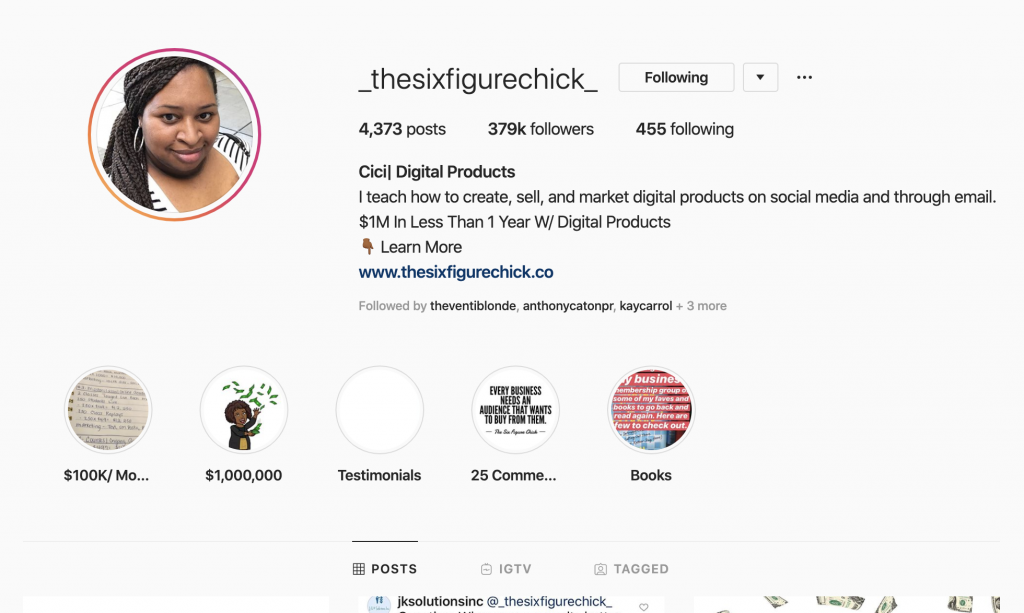
Looking at Cici the “Six Figure Chick”…

She has an Instagram profile, which she updates daily. This is where new followers find her, and where she keeps her community engaged until they are ready to buy from her.

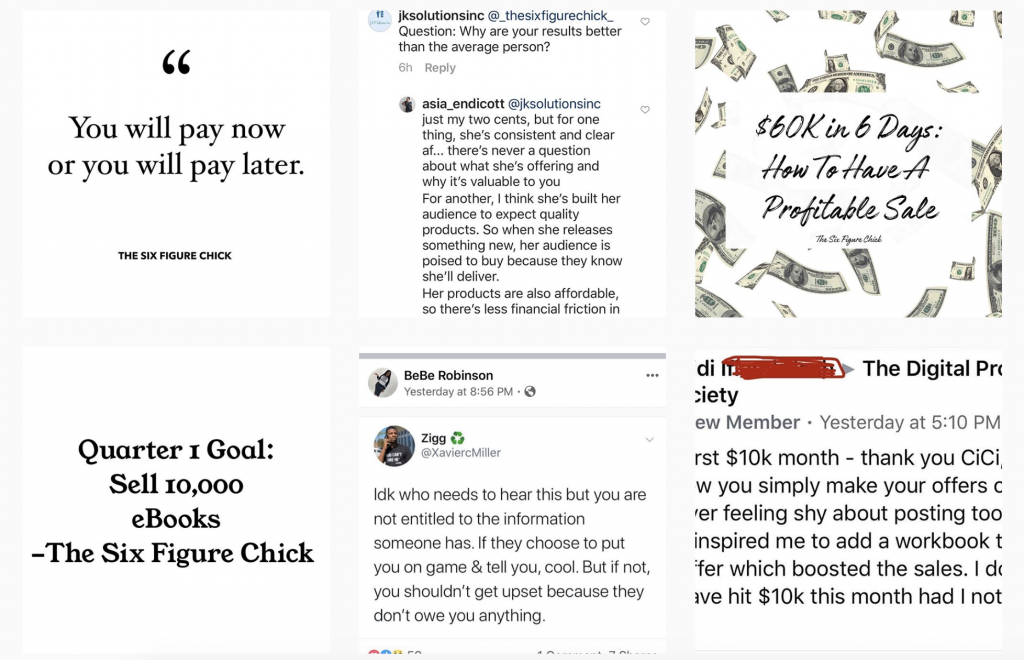
She keeps people engaged with a mixture of Inspirational content and advice on building personal brands and businesses on Instagram.

While at first glance it would seem like there is nothing original here, she is one of the best people in the game as far as I can tell. Her delivery is rough around the edges, but she is VERY consistent and knows her market inside out. She’s built an amazing business and should be commended for it.

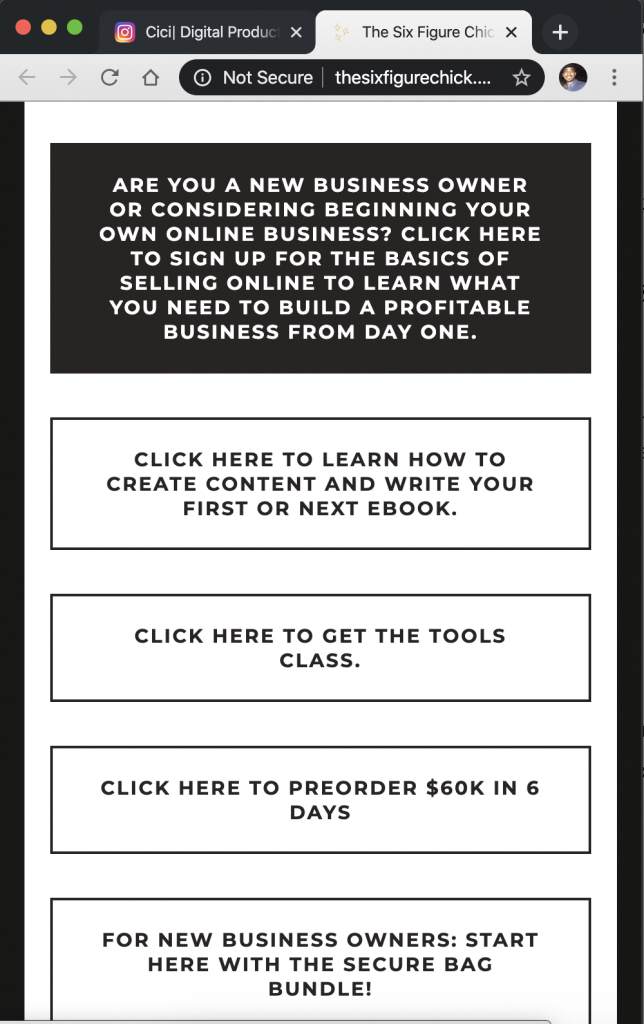
Back to her funnel – The link in her bio leads to a landing page with links in it…

The design of this page is very simple, clean and, to the point. It’s simply buttons with text on them, pretty much what I was trying to achieve with lnks.to

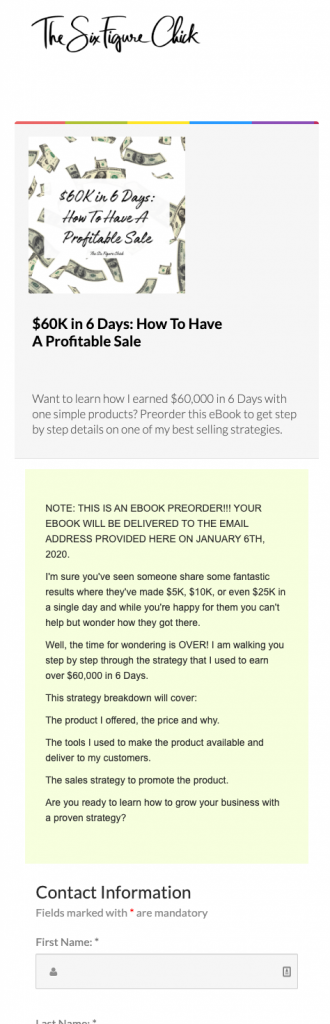
When you click on the links they all lead to a samcart.com page selling everything from free ebooks to $1,000+ consulting packages…

When you sit back and think about it, it’s classic internet marketing: “Buy my ebook on how I got rich selling ebooks” LOL, but it works.

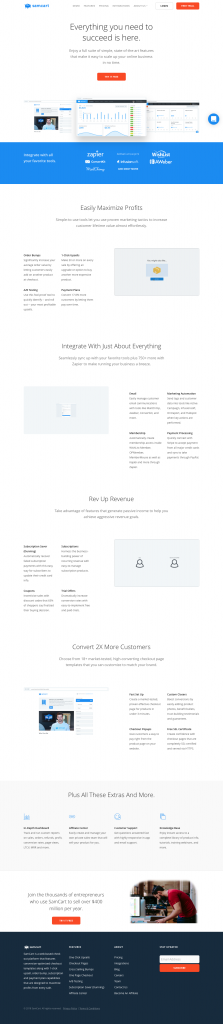
While I have never used or even looked at SamCart in the past, it looks like a solid, feature rich platform…

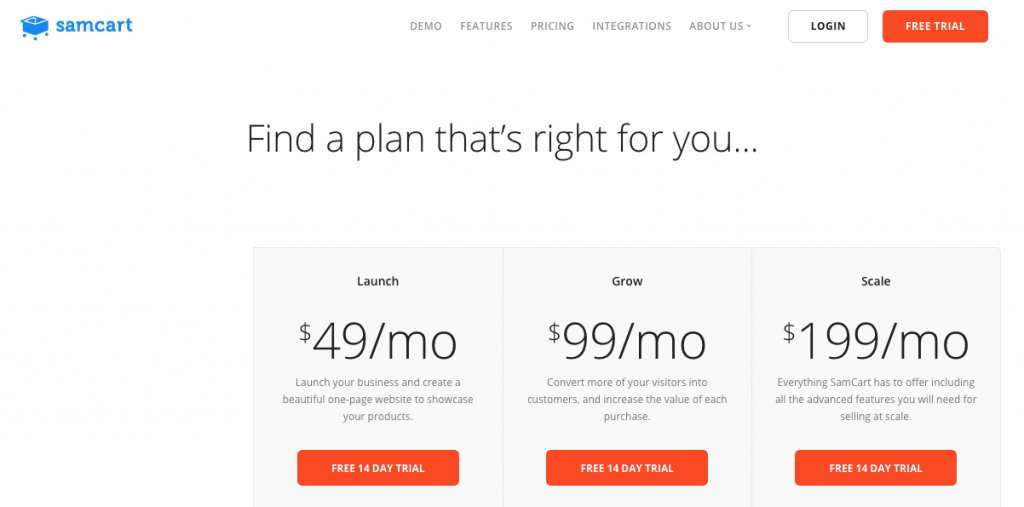
Interestingly, you pay monthly for this platform…

This is good to know, while it would take me some time before I am able to compete from a features perspective, it means the market may not be against paying monthly for platforms like this. Having said that, I wouldn’t know what to do about transaction fees. I would have to pay these myself. While they could be rolled into the monthly fee, I think that would be a risky play.

It just occurred to me that it might be worth making a membership site, so form people pay to have access to your entire volt. Or maybe they pay to get access to the information, which is kinda in the site so there can always be ads to other things right by the content. You can add ads to ebooks as I have done lots of times in the past, but they will be out of date shortly if not handled well. I could potentially do a video on how I went about building ebooks.

Back to looking at the funnel…

Looking at Cici’s SamCart landing pages, it looks like you’re buying ebooks

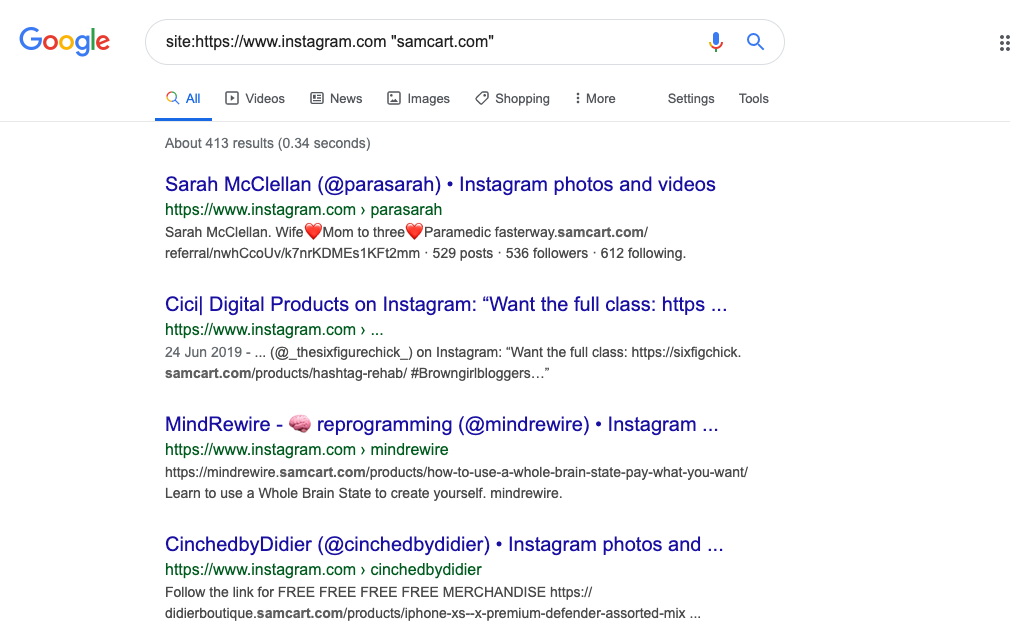
Doing a quick search to see if many instagram accounts are linking to SamCart pages…

Only 413 results. This suggests that I am looking at this in the wrong place.

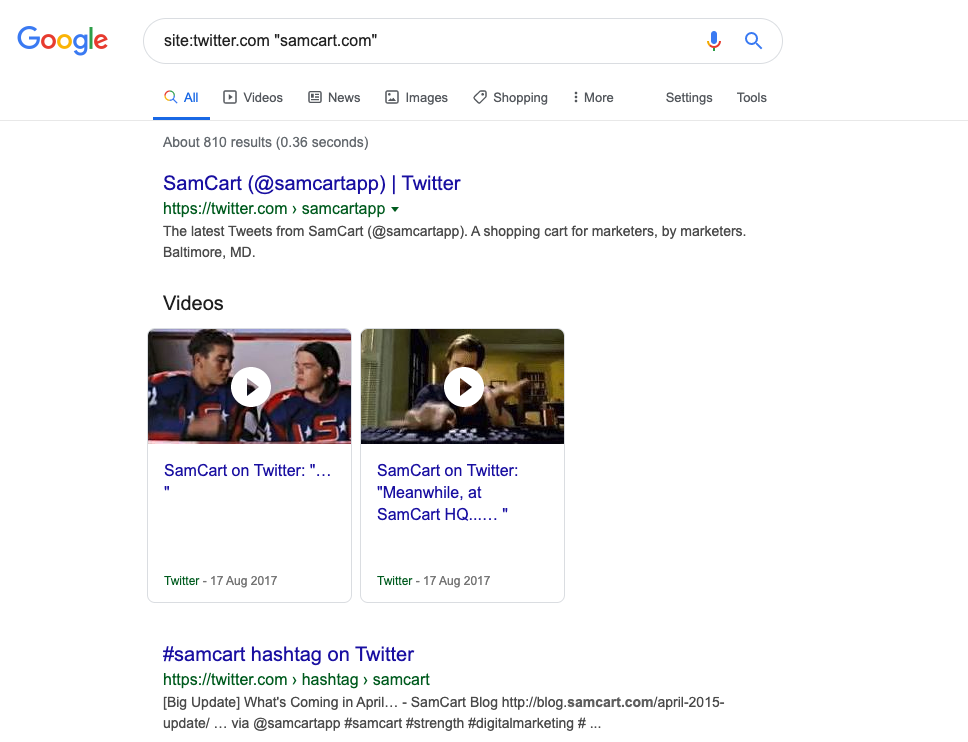
I will check twitter and then see if I can search linktr.ee

…again, not much with twitter…

Not much here for now, but back to looking at Cici’s funnel…

When you go to her site, interestingly the home page is the collection of links as seen above but, there are other pages…

She’s got…

  • A blog
  • Earn with Cici, leads to the page with links
  • About, is her story
  • Contact page

Very simple site, most of her efforts are on Instagram so, not sure she’d need much else. Interestingly, she (and I have seen this on many other sites) has a page where she talks about tools she uses on a regular basis…

This post allows me to see what tools she uses and what she likes about them. It also has comments from some of her followers. This means I can see what some of them are interested in and what their likes and dislikes are.

I can go through this to work out what she’s using and look for subscription based tools. Knowing that this is one of the common behaviours in this market makes it much easier to look for ideas. It also means I might be able to reach out to these creators to see if they would be interested in creating a review for sharing with their followers. This can be a really powerful way to grow, especially when linked to an affiliate or referral program.

I’ve got to take a break for now as I have to make something to eat and sort out some stuff before the day is over, but at least it’s a step in the right direction.